
It is always a treat when a guest captures the soul of what we do here at Northwest Flying Inc. better than we ever could. A huge shout-out to Tammy M. Tschida for the 5 Star Review and for sharing these fantastic snapshots of her trip to the Nestor Falls area.
We love the photos and video clip of the take off! I’m reminded why I never get tired of coming to “work.” Here is a breakdown of the story Tammy told through her lens:
Thank you so much for sharing.

The satellite image of Nestor Falls area near Northwest Flying Inc., nearby accommodations, and the surrounding natural landscape of water and forests.
The Star of the Show: Our Polished Beech 18
Tammy caught a stunning shot of our polished Beechcraft Model 18 resting right at the dock.
- The Shine: You can see the reflection of the Canadian sky and the surrounding treeline on her fuselage. Keeping that finish looking like a mirror is a labor of love, but when the sun hits it like that, it’s worth every hour of buffing.
- The Gear: She’s sitting tall on her floats, ready for the next run into the bush. You can even see one of our team members near the rear float, likely giving her a final check before we head back out.
- The Backdrop: In the background, there’s our storage shed and a quiet morning at the base—the calm before we start hauling gear and guests to those remote outposts.

The View from the Front Office
One of my favorite shots Tammy shared was from inside the cabin.
- Expert Hands: She captured our “experienced pilots” (her words, and we happen to agree!) at the controls.
- The Cockpit: You get a great look through the windows, showing off that classic cockpit geometry that makes the Twin Beech such a legendary bird to fly.

Why We Do It: The Nestor Falls Landscape

Tammy also snagged a beautiful aerial view of the lake country.
- The Commute: The photo shows the vast, green islands and deep blue waters that our guests get to see every time they fly with us.
- The Mission: As Tammy mentioned, we specialize in taking folks to remote resorts only accessible by flying. Whether it’s for world-class fishing or just to escape the grid, that view from the window is the moment the vacation truly begins.
Seeing our Northwest Flying Inc. sign and our gear-loaded carts in her gallery reminds me that every bag we load is the start of someone’s adventure. (Harley is keeping close watch for any stray donuts that might fall off the cart 🙂

Thanks again, Tammy, for the kind words and for perfectly capturing a day in the life of a bush plane operation.
Our guest photos and videos stick with me.
Green islands scattered across deep blue water, no roads, no rooftops, no cell towers. Just wilderness. And somewhere down in that maze of lakes and shoreline, a cabin with your name on it for the week.
If you’ve been scrolling through photos like Tammy’s and wondering what a fly-in fishing trip actually involves—whether it’s worth the investment, whether your group could handle it, whether the fishing really lives up to the hype—this one’s for you.
So What Exactly Is a Fly-In Fishing Trip?
A fly-in trip means we load your gear into a floatplane and fly you to a lake that has zero road access. No highway pulloffs, no public boat launches, no one else. Your group is the only group on that entire lake for the duration of your stay. That’s what “exclusive access” actually means when we say it—one cabin, one group, one lake.
Compare that to a drive-to lodge where you’re sharing water with other guests, locals, and anyone else who trailered a boat to the launch. The fishing pressure difference is enormous. On our remote fishing outposts, the fish haven’t seen many lures, which means they’re more aggressive and you catch more of them.
And then there’s the flight itself.
Tammy nailed it when she photographed that moment from the cockpit—the windows of the Twin Beech framing a legendary piece of aviation history while the wilderness unfolds below.
Whether you’re a nervous flyer or an aviation enthusiast, that 15-to-25-minute ride over the lake country is the moment the trip stops being a plan and starts being an adventure.
Is It Worth the Cost Compared to a Drive-To Lodge?
This is the most common question we hear, and it’s a fair one. A fly-in trip is an investment. But here’s what our repeat guests—some of whom have been fishing with us for decades—consistently tell us: they’d rather go fly-in every other year than drive-to every year.
The reason is simple. On a drive-to lake, you’re competing for the good spots. On a fly-in lake, every point, every bay, every weedline is yours.
The walleye fishing alone justifies it for most groups—we’re talking 50 to 100 fish days during peak season on lakes where the fish are healthy, aggressive, and genuinely surprised to see a jig. You can check our rates to get specific numbers, but when you break it down per day of fishing on a private lake, the math starts to look pretty reasonable.
How Remote Are We Talking?
Remote enough that a guest’s aerial photo shows nothing but water and forest to the horizon. Not so remote that you’re roughing it in a canvas tent.
Our outpost cabins are first-class—newer builds with full solar power, backup generators, running hot and cold water, indoor showers, full kitchens, and large freezers. You’ve got 14-to-16-foot aluminum boats with reliable Yamaha 4-stroke motors and unlimited fuel included. It’s off-the-grid living with modern comforts, which is a combination that surprises a lot of first-timers.
The flights to all five of our outpost lakes are intentionally short—Kishkutena Lake is just 8 minutes from base, and even our furthest lake, Gordon Lake, is only 36 minutes out. That means more time fishing and less time traveling, which matters when you’re paying for every day on the water.
What Should a First-Time Group Target?
If your crew is a mix of experience levels—a couple of seasoned anglers and a few who haven’t picked up a rod since summer camp—walleye and northern pike are your best entry point.
Walleye are consistent biters on low-pressure lakes, and they’re the foundation of the legendary Ontario shore lunch tradition. Northern pike are the crowd-pleasers—aggressive, explosive, and willing to chase down almost anything you throw. Even beginners get that heart-pounding strike on day one.
For groups with more experience or a specific obsession, smallmouth bass deliver pound-for-pound the hardest fight you’ll find in freshwater, and lake trout offer a deep-water challenge that rewards patience and technique. And if someone in your group has been dreaming about trophy muskie—the fish of 10,000 casts—we’ve got lakes where 50-inch fish are a legitimate possibility.
The beauty of a place like Loonhaunt Lake is that you don’t have to choose just one species. It’s our most popular outpost precisely because it offers all five—walleye, pike, bass, lake trout, and muskie—in a sprawling system with enough structure to keep you exploring all week.
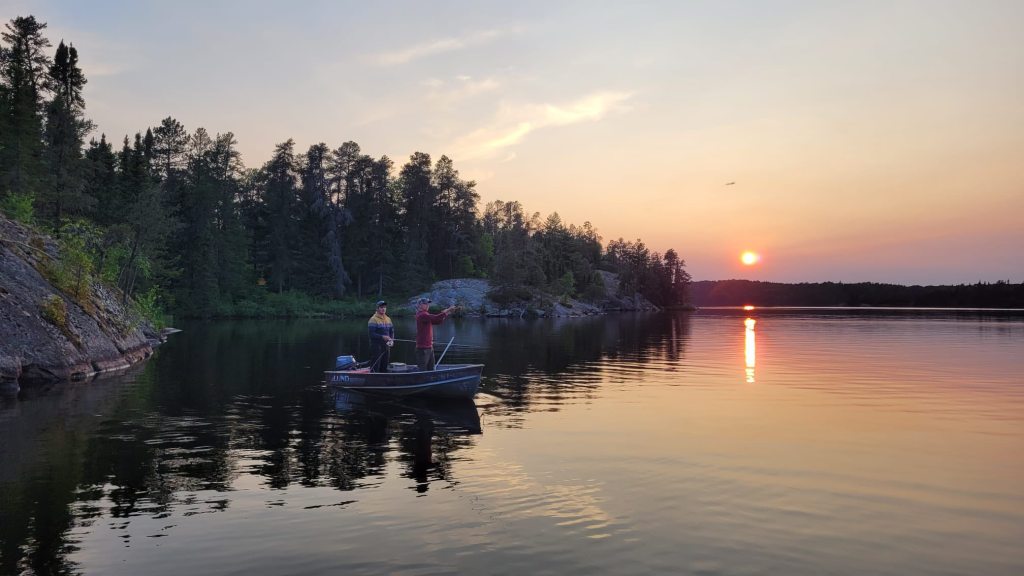
Do You Have to Be an Expert to Enjoy This?
Not even close.
The low fishing pressure on these lakes means the fish are forgiving. Walleye will hit a simple jig-and-minnow presentation even if your technique isn’t textbook. Pike will attack a spoon on a straight retrieve. You don’t need to be a tournament angler to fill a stringer for shore lunch.
That said, these are self-guided trips. We’ll give you a detailed lake map, walk you through the best spots, and make sure you know where the structure is. But once the floatplane lifts off the lake, you and your group are on your own. Most first-timers figure out the rhythm within a few hours—and the learning curve is half the fun.
When Should You Go?
Timing changes the character of the trip significantly.
Late May through June is peak action. Walleye are aggressive post-spawn, pike are cruising the shallows, and catch rates are at their highest. The tradeoff is bugs—blackflies can be intense in early season, so come prepared.
July and August offer the best weather, calmer bugs, and excellent fishing, though the fish move deeper as the water warms. This is prime time for lake trout jigging and finding bass on rocky structure.
September is trophy season. The fish are feeding aggressively before ice-up, the bugs are gone, and the fall colors across the boreal forest are stunning. If a personal-best walleye or a giant pike is on your bucket list, fall is when it happens.
Most groups land somewhere in the mid-June to August window for the best balance of weather, bugs, and fishing quality. You can always check the Nestor Falls weather as your trip date approaches to start planning your layers.
How Physical Is It?
Tammy’s photos tell this story well. The floatplane drops you at the dock. Your cabin is right there. You fish from a boat with a motor. The most physically demanding part of the trip is carrying groceries from the plane to the kitchen and filleting the day’s catch.
We’ve hosted groups with anglers in their 70s who had no trouble at all.
The key consideration isn’t fitness—it’s comfort with being off the grid. There’s no hospital down the road, no quick exit. If someone in your group has serious health concerns, that’s worth a conversation before you book.
What About Couples, Families, and Non-Anglers?
The floatplane experience alone is worth the trip for a lot of people. Landing on a remote lake in a classic bush plane, watching eagles and moose from the cabin deck, sitting around a fire under a sky full of stars with no light pollution for miles—these aren’t fishing-only experiences.
For most, the primary activity is fishing. If someone in your group genuinely has no interest in being on the water, they’ll need to be comfortable with solitude, reading, photography, and the rhythm of wilderness time.
For families, kids are half price on outpost trips — two full-paying adults for each discounted child — and there’s something about a multi-generational trip to a place like this that creates stories people tell for the rest of their lives.
The Photo That Started All of This
Back to Tammy’s gallery. That image of our polished Beech 18 on the dock—the Canadian sky reflected in the fuselage, a team member doing a final check on the floats, the quiet in the early morning before the day’s flights begin—that’s the moment before everything starts. Every bag we load onto those carts is the beginning of someone’s story.
We’ve been writing those stories since 1963.
Multiple generations of guests.
Experienced bush pilots who know every lake, every reef, every wind pattern in this part of Northwestern Ontario. And a simple philosophy: put good people on great water and let the fishing do the talking.
If Tammy’s photos made you feel something—curiosity, excitement, maybe a little bit of that pull toward something you can’t quite explain—that’s the same thing every one of our guests felt before their first trip.
The next step is a phone call.
Give Shane a call at 1-800-461-2126 and tell him about your group. He’ll match you to the right lake, walk you through the logistics, and answer every question that may not be in our Frequently Asked Questions.
And when you come back from your trip with your own photos and your own stories, we’d love to feature them. That’s how this works. Tammy shared her experience, you’re reading about it now, and maybe next year someone will be reading about yours.
That’s the Northwest Flying family. It’s been growing since 1963, and you can check our availability calendar to see if there is room for one more group.
Discover more from Northwest Flying Inc
Subscribe to get the latest posts sent to your email.