
What a Fly-In Fishing Week Actually Looks Like
A fly-in fishing week is three to seven days at a cabin on a remote Northwestern Ontario lake you can only reach by floatplane, where your group runs its own boats, cooks its own meals, and keeps its own schedule.
This is what you’re preparing for — built from what actually happened at our Nestor Falls outposts in May, June and July 2026, and from the photos guests sent back.
The flight, the lake, the cabin, the fish and the food — what a fly-in fishing week at a Northwest Flying outpost actually involves.
The morning you leave
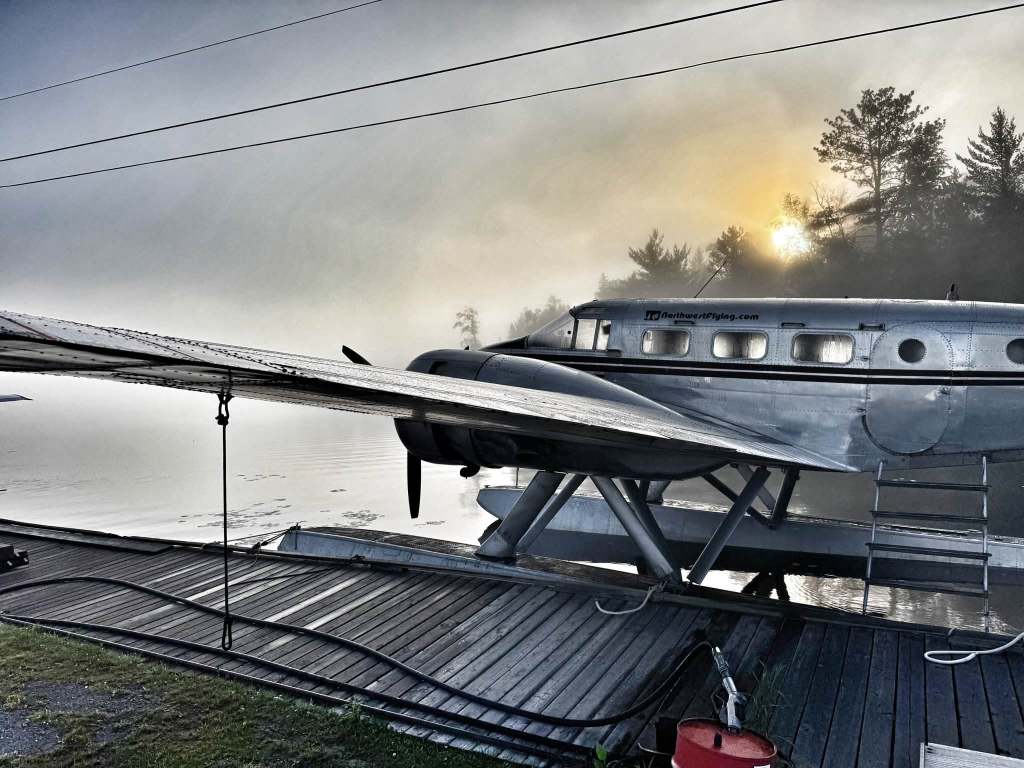
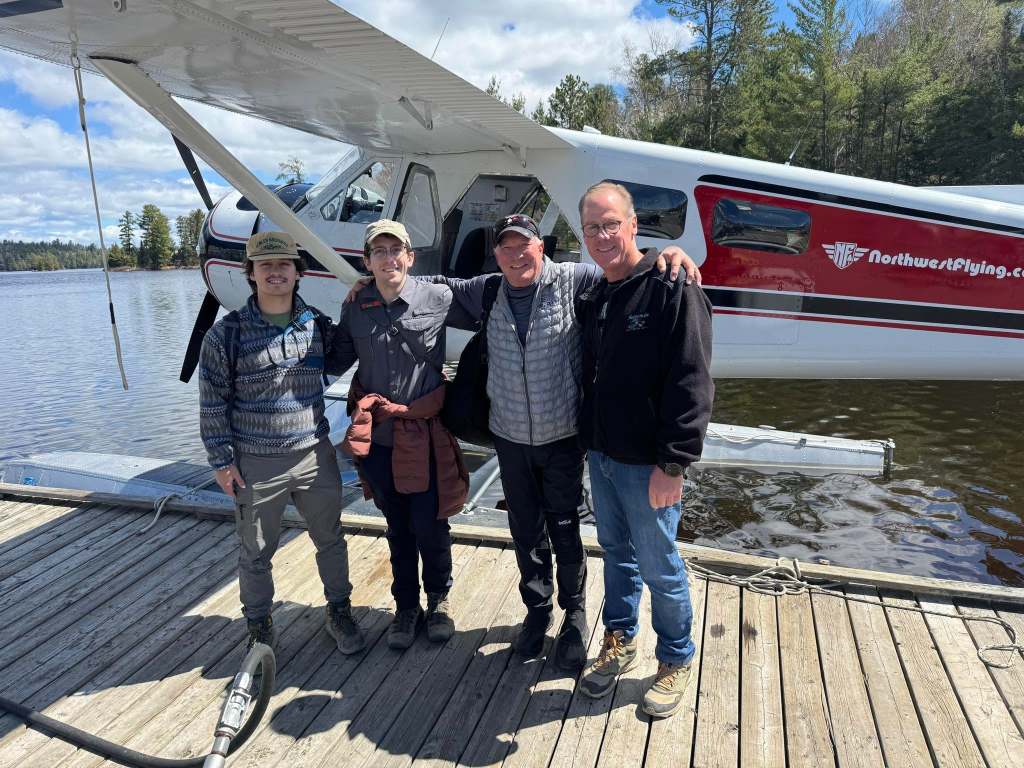
Your day starts at our base at Nestor Falls, before 9:00 a.m. Trips depart between 9:00 a.m. and noon unless we’ve arranged otherwise.
By the time you pull in, groceries should be bought, licences should be in hand, and your gear should be sorted — because the next thing that happens is that it goes on a scale. Each angler is allowed 100 pounds, based on a minimum party of four. It’s the one hard number in the whole trip, and the packing list and Before You Fly exist to make sure the morning of your trip isn’t the first time you think about it.
There’s a moment on that dock, usually right around the time the engine starts warming, when a group that has been planning this for eleven months finally stops planning it. We see it a couple hundred times a summer.
What the flight in is like

You take off from the water at Nestor Falls and land on the water at your lake, at a dock in front of your cabin. Depending on the day and the load, that’s a Beech 18, a de Havilland Beaver, or a Cessna.
The flight is not the part you get through to reach the fishing. Ask anyone who’s done it. About ten minutes out, the roads stop — and it’s rock, water and trees to the horizon in every direction. Most first-time groups go quiet and stay quiet the rest of the way, faces at the windows.
The aircraft are older than most of the people who ride in them, and they do this every morning of the season. If you want to know what that looks like from the outside, the aircraft gallery is worth a minute — much of it shot by people who came here as guests and went home as photographers.
The first afternoon

The aircraft taxis in, you unload onto the dock, and it leaves. That’s the moment the trip actually begins, and it’s a strange and good feeling the first time.
What’s waiting for you: the cabin, boats, motors, fuel and paddles, minnow buckets and cushions, a fully equipped kitchen with a BBQ and a fish cooker, fresh towels and pillow cases, and a satellite messenger. The full equipment detail lives on the outposts overview.
Most groups get the gear inside, argue briefly about bunks, and are on the water by mid-afternoon. Nobody has ever waited until day two.
What the middle days look like
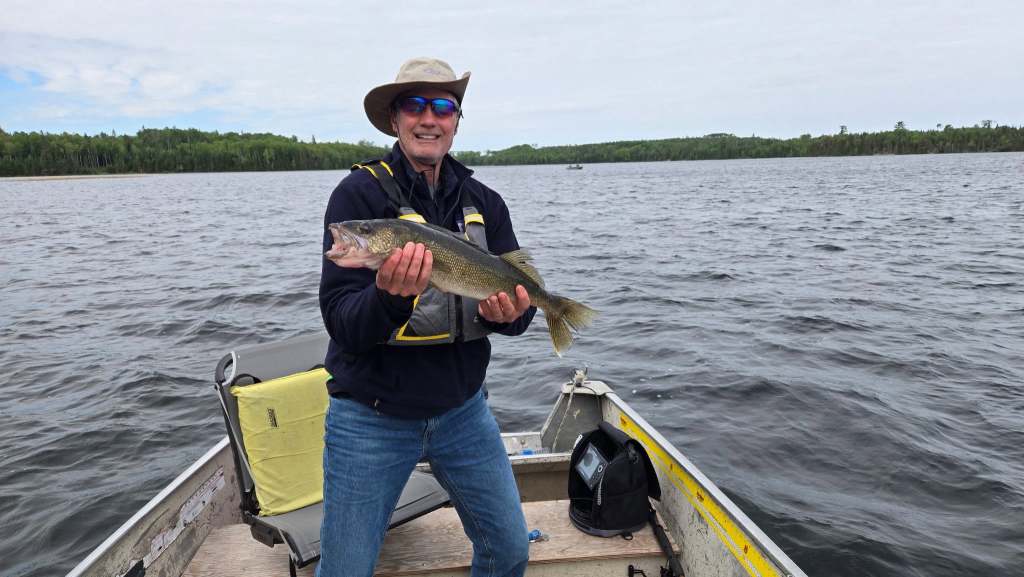
There is no schedule. You fish when you want, come in when you want, and eat when you’re hungry. That’s the whole design of an outpost trip and it’s why people who do one tend to keep doing them.
A day on Loonhaunt in June 2026 ran roughly like this. Morning: a man in a red jacket with one walleye, grinning like it’s the first fish anyone has ever caught. Midday: a bigger one, thick across the shoulders. Afternoon: three men on the dock, three stringers, and the specific posture of people who have been in a boat since six in the morning. Evening: fillets in the fish cooker.
Somewhere in most weeks a northern pike shows up and turns a quiet afternoon loud. Nobody plans a trip around pike. Everybody remembers them.
What you do with the fish you keep
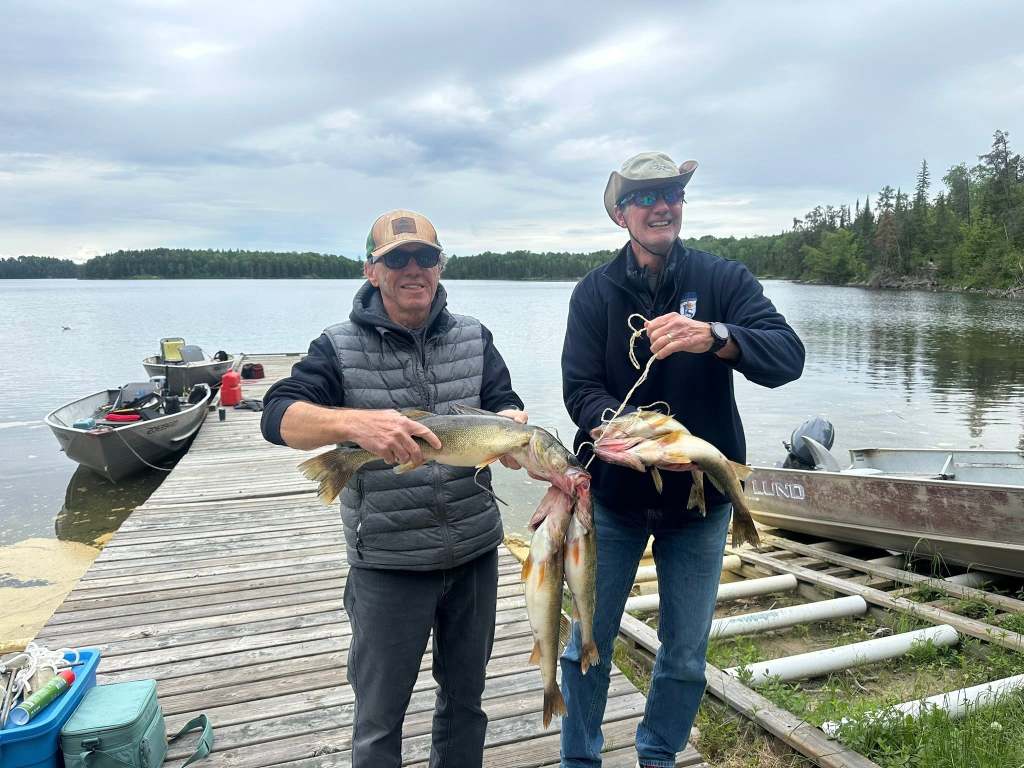
You cook it, at the cabin, in the kitchen and fish cooker that are already there. Fish caught at two in the afternoon is on a plate by six.
This is the part first-timers ask about, usually a little sheepishly: if we catch them, then what? And it’s a bigger deal than it sounds. A meal you caught, cleaned and cooked yourself, on a lake nobody can drive to, is not the same thing as dinner. Groups who’ve done it will tell you it’s half the reason they come back.
Which raises the question that stalls more first bookings than price does: how much food do eight adults need for six days when part of every dinner is a fish that hasn’t been caught yet? That’s not a guess you should have to make. The meal plan works it out for four people and for eight, by weight.
The part nobody expects
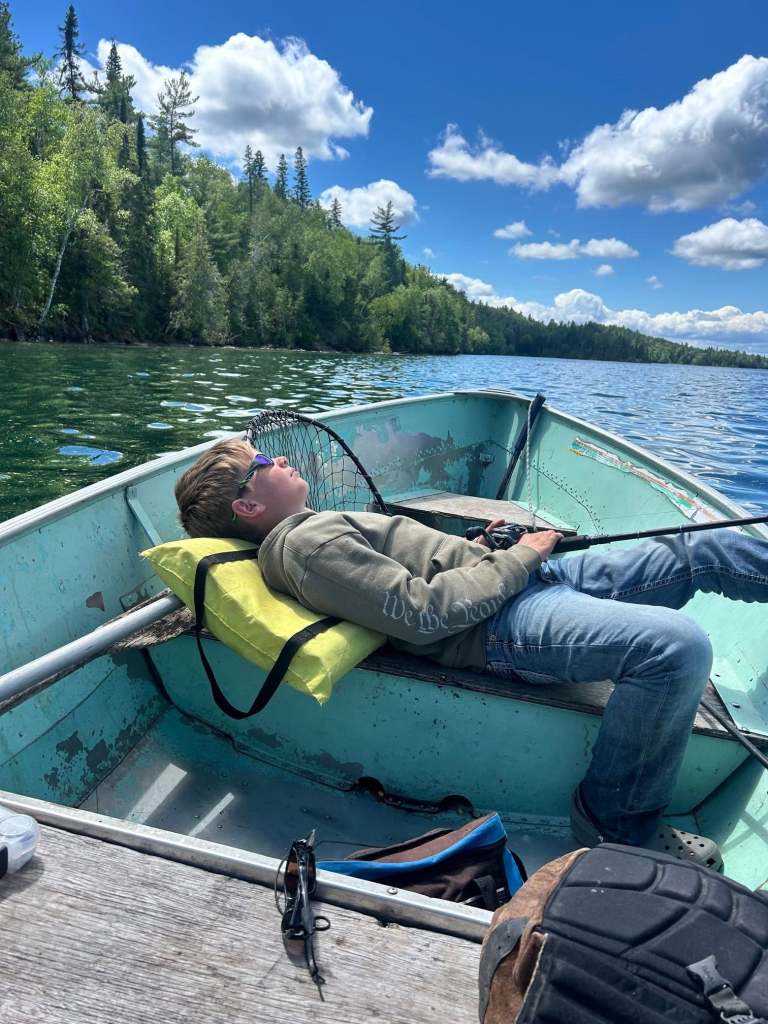
A good portion of a fly-in week is spent doing nothing at all, and it turns out that’s the point.
Four men in the screened porch at Loonhaunt with coffee and folding chairs, not saying much. A man flat on his back across the seats of a boat, life jacket still on, hat over his face, out cold. Somebody crouched over a pot on the fire rocks. Wieners on sticks and marshmallows going black over the coals at the end of the day.
Nobody flies four hundred miles for a hot dog. Ask a man why he books a fly-in trip and he’ll tell you about walleye. Ask him in November what he remembers and he’ll tell you about the people who were there.
Does it work for kids and multi-generational groups?

He is going to remember this for the rest of his life.
Yes, and it’s a lot of what we fly.
Kids are half price on outpost trips, with two full-paying adults for each discounted child — see the rates page.
The groups that come back year after year are usually not four buddies. They’re a grandfather, a son, a grandson, and a friend who’s been coming so long he might as well be family. The appeal of a lake with no road to it is that there is nothing else to do and nowhere else to be. Six days of that, with three generations in one cabin, is a rare thing to be able to buy.
Would our kids actually like it? is the question that decides whether a lot of these trips ever happen — and the real answer is in the photo above, not in anything we could write.
Which lake, and what’s in it
Two things decide it: how many people you have, and what you want to catch.
| Lake | Sleeps | Species |
|---|---|---|
| Ajax | 8 | Walleye, Northern Pike, Smallmouth Bass, Lake Trout |
| Cleftrock | 6 | Walleye, Northern Pike |
| Gordon | 6 | Walleye, Northern Pike |
| Kishkutena | 6 | Smallmouth Bass, Muskie, Lake Trout |
| Loonhaunt | 8 | Walleye, Northern Pike, Smallmouth Bass, Lake Trout |
If your group is eight, it’s Ajax or Loonhaunt. If you want muskie, it’s Kishkutena. If you want walleye and pike with nothing else on the water complicating it, Cleftrock or Gordon. If you want the widest mix — walleye, pike, smallmouth bass and lake trout in the same week — Ajax or Loonhaunt again.
Not sure? Describe your group on the phone. Choosing the lake is the part we’re actually good at.
Does the month you pick change the fishing?
It changes where the fish are, not whether you catch them. Our season runs from ice-out in spring through October, and the fish are catchable the whole way. What moves is location and depth.
Late May is a particular kind of week. The water is still cold, the bugs haven’t found their enthusiasm yet, and the fishing has a seriousness to it that August doesn’t. Walleye are shallow and the days feel long.
June is when most of the photos on this page were taken. Warm mornings, the walleye bite on Loonhaunt, lake trout still willing, and long evenings around a fire.
July and August push the walleye deeper and the smallmouth bass onto the rocks, and the weather is at its most forgiving — which is why it’s the family window.
September and October are the muskie months at Kishkutena.
None of those months is better than the others. A group that knows where the fish have moved catches fish in any of them, which is why the most useful thing you can do before you book is ask us where they’ve been holding.
If a week is more than you want to start with
There is a second way to do this: fly-in camping and day fishing, on nine lakes, starting at one day. Round-trip airfare from Nestor Falls, boats, motors and gas are included. No cabin, no kitchen, no fish cooker — you bring your own everything.
Arrow, Barass, Carsten, O’Dell, Shingwak, Otterskin, Horseshoe, Ashigami and Back Lawrence. Arrow holds walleye, northern pike and bass and has nine boats on it. Shingwak has bass, lake trout and muskie and four boats. Here’s how it works, and what it costs.
It’s a different trip for a different kind of group. Some people want the cabin, the BBQ and the towels. Some people want an aircraft to set them down on a lake and then go away. And a lot of people use a single day to find out which one they are.
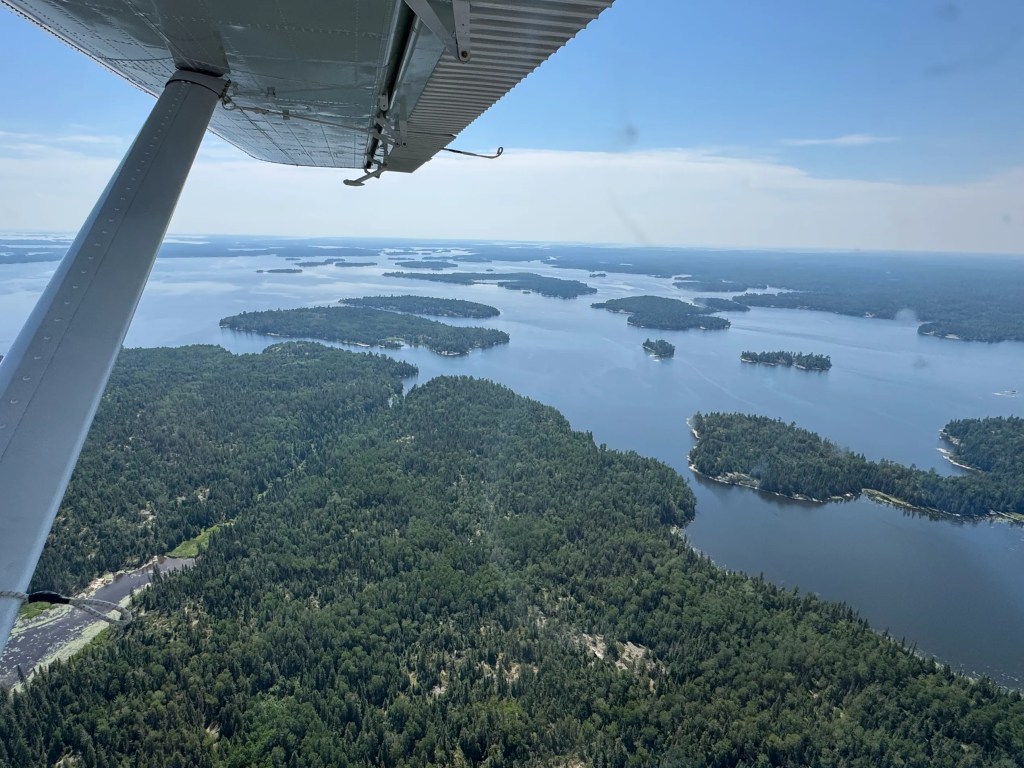
Anne Caten booked a sightseeing flight in July 2026 and it turned into a day of fishing on Arrow Lake instead. She brought a chihuahua. Afterwards she wrote that they were timely, got her there, and picked her up when they said they would — and that she was ready for the next trip. Then she sent us the photograph above.
Summer 2026, in what guests sent back
- May 21 — the Carlson gang’s return trip to Shingwak Lake. Fly-in camping, four boats, and a group that doesn’t need anything explained to them.
- June 8 — a Beech 18 into a remote outpost, a boy with a lake trout bigger than his arms, campfire cooking, and marshmallows after dark.
- June 2026, Loonhaunt Lake — the walleye bite, three stringers on the dock, a fish fry, and a man asleep in a boat.
- July 7 — fog over the Nestor Falls airbase at sunrise, the Beech 18 on the water, nobody around.
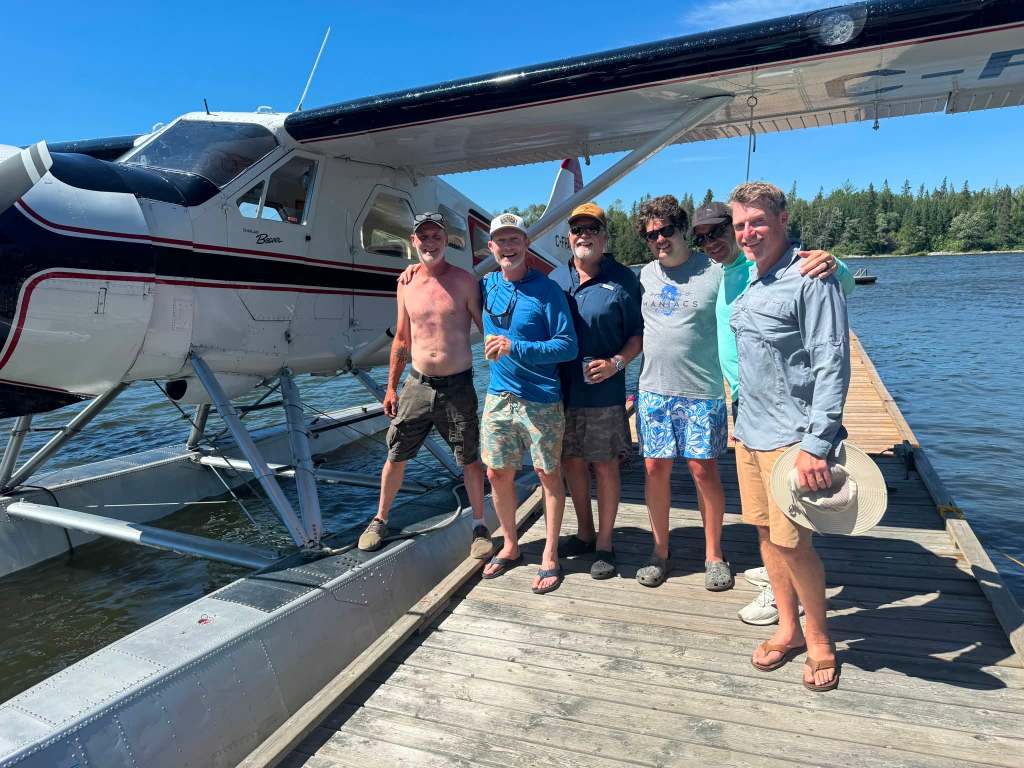
- July 13 — six friends on the dock in front of the Beaver. Half in shorts. No fish in the frame.
The full set of summer 2026 photos, and the stories behind them, are in our guest stories.
What a week costs, and how it’s booked
Outpost rates are per person and don’t change with the size of your group — so the eighth angler on an eight-person cabin doesn’t cost the other seven anything. Minimum party of four. A deposit confirms your dates, with the balance due on arrival. Taxes are extra.
Current rates for every trip length, and what each package includes, are on the rates page — the one place that detail lives, so it’s always right.
Two ways to start
You can tell us your group size, your dates and what you want to catch, and we’ll tell you which lake fits. That’s a five-minute call and it costs nothing. Or you can do what Anne did — book a single day on one of the camping lakes and find out for yourself.
Most of the people who have been flying with us for twenty years started with one or the other.
Call Shane at (800) 461-2126 or (807) 484-2126, or get in touch here. When you’re ready to work through the details, the rest of this guide is waiting: what to pack, the meal plan, pro packing tips, and before you fly.
Your escape.
Photographs by our guests. Aviation photography courtesy of Bill Campbell and Anne Caten.
You must be logged in to post a comment.